
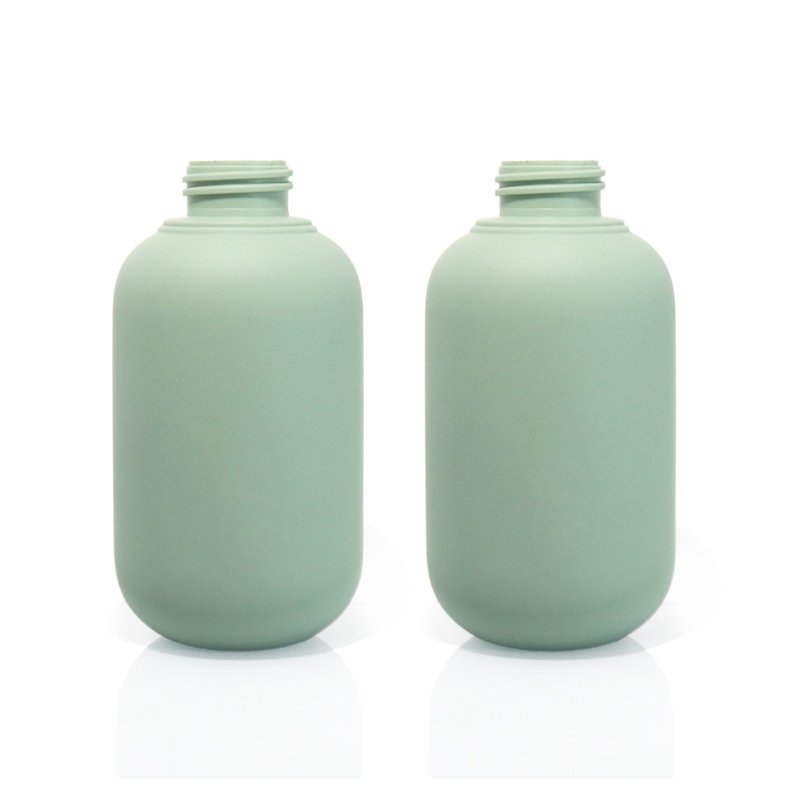
Bottle colour drifts between production batches because of dosing, heat and material variables you can measure. The control is a Delta E band around a retained master sample, plus written rules for re-tinting and re-qualification.
A brand approves a colour, the first lot matches, and three lots later the bottles read a shade off. The reflex is to blame the factory. The useful move is to understand that colour on a moulded bottle is a process output, not a fixed property: the same mold, masterbatch and resin code still produce a measurable shift between lots. What separates a manageable supplier from a chaotic one is not the absence of drift, but a defined band, a retained master sample, and agreed rules for a lot that lands outside the band. This guide covers where drift comes from, how to measure it in Delta E, the master-sample protocol, the re-tint decision, the re-qualification triggers, and what to write on the purchase order.
Batch colour at a glance
- Drift is normal: The same mold and the same masterbatch still produce a measurable colour shift between lots. The specification is a Delta E band around the master sample, not an exact match to the first batch.
- The main cause: Masterbatch is dosed at a let-down ratio of roughly 1-5%. A dosing error of a fraction of a percent moves the whole lot, so dosing accuracy is the first thing to audit when colour drifts.
- The bands: Delta E under 1.0 reads as a match to a trained eye; 1.0-2.0 is the usual commercial band; beyond 3.0 the difference is visible side by side. Set the band on the PO before the first run.
- The master sample: One retained, signed sample per approved colour, plus its CIE Lab readings, beats any memory of the approved shade. Keep it sealed, labelled and out of the light.
- ShiJin: 1,000+ open molds in PET, HDPE and PETG; MOQ 5,000 units; 15-25 day lead time. We hold the approved master sample and report the per-lot Delta E against it, so drift shows up as data, not as an argument.
Why Colour Shifts Between Batches
Colour on a moulded bottle comes from masterbatch, a concentrated pigment carrier dosed into the resin at a let-down ratio of roughly 1 to 5 percent. That small fraction is where drift is born: if the dosing slips by a fraction of a percent, the whole lot moves, because there is no second correction downstream. A feeder slightly out of calibration, or a hopper not purged between colours, shows up in every bottle of the run.
Heat is the second lever. Colour develops as the resin melts, so dwell time and melt temperature change how the pigment reads. A hotter, longer dwell deepens a shade; a cooler, faster cycle leaves it pale and streaky. Two machines running the same mold at different settings will not match, which is why a line move is a colour event, not just a capacity event.
Material inputs matter too. Regrind, the reclaimed runner and rejected-bottle content, dilutes the pigment feed, so a high-regrind lot reads lighter than a lot on virgin resin. Resin lots vary slightly in base colour, and the same masterbatch reads differently on clear PET, white HDPE and PETG because the substrate tints the result. None of this is a defect; it is process noise, and the response is a measured band, not an expectation of zero. Our masterbatch versus pre-coloured resin guide explains how the colouring method changes the drift profile.
Measuring Drift: Delta E Bands
You cannot manage what you cannot measure, and the measurement for colour is Delta E, a single number for the distance between two colours in CIE Lab space. Under 1.0 reads as a match to a trained eye; 1.0 to 2.0 is the usual commercial band for packaging; beyond 3.0 the difference is visible side by side. Our Pantone and Delta E specification guide covers the formulas and illuminants, so the numbers here build on that base.
The measurement has to be controlled or it lies. Read the master sample and the lot sample under the same illuminant, with the same instrument geometry, on the same part of the bottle, because a glossy shoulder and a matte label panel do not read the same. Record the reading with the lot, not just a verdict, because a trend of small drift inside the band warns that the process is walking toward the limit.
Bands should be set by product, not by mood. A premium glass-look jar on a white shelf can hold a tight band; a textured, high-regrind body bottle needs a wider one. Write the band as a number, tied to the master sample, before production starts, so the factory aims at a target instead of remembering one. A trend line of per-lot readings beats a single inspection certificate.
The Master Sample Protocol
The master sample is the reference every lot is judged against, and it fails in predictable ways: it gets lost, it fades, or nobody agrees which sample was approved. The protocol fixes all three. At approval, one physical sample is signed, dated and labelled with the shade reference and the Delta E reading taken against the standard. It is stored sealed, upright and out of direct light, because UV and handling both move a retained sample over months.
Two artefacts beat one. Keep the physical sample for visual judgement and the recorded Lab values for instrumental judgement, so a faded reference cannot silently redefine the approved colour. When the physical sample degrades, the numbers still stand, and a new retained sample can be cut from a verified lot. Store a second set off-site, so a fire or a lost box cannot erase the standard.
Tie the master sample to the lot code, not to the product name. Our batch coding and traceability guide covers how lot numbers link a delivered carton back to its production run, which is what makes the master sample auditable instead of anecdotal. The sample approval workflow guide shows where it sits in the wider approval sequence.
When a Lot Fails: Re-Tint, Re-Run or Concession
A lot outside the band has three honest outcomes, and deciding them in advance keeps a colour problem from becoming a schedule problem. The first is re-tint: add masterbatch and re-run to pull the reading back toward the master. Re-tint works for a small miss, but it is not free, because each extra pass adds dwell time and regrind content, which move colour again. One correction with a re-measure is normal; a third means the process is out of control and the batch should be re-run on fresh material.
The second outcome is a full re-run on virgin resin, which resets the regrind dilution and the thermal history. It costs lead time, so it should be a documented decision with a date, not a loop of small corrections. The third is a concession: the lot sits slightly outside the band, the brand accepts it in writing for a specific order, and the deviation is recorded against the lot code.
What is not an outcome is shipping quietly and hoping nobody measures. A lot shipped against a recorded deviation is a business decision; an unrecorded one is a quality escape that surfaces at goods-in or, worse, on shelf. Our incoming-inspection guide shows how to catch the escape at the dock with a measured sample rather than a glance.
Re-Qualification Triggers
An approved colour is only approved for the conditions it was approved under. Change one of those conditions and the approval lapses until it is re-measured. The four triggers that matter are the resin source or grade, the masterbatch batch or let-down ratio, the mould or machine, and the colouring method itself. Each moves colour through a different mechanism, which is why a visual check alone is not a re-qualification.
A new resin lot is the mildest trigger: it usually holds within the band, but it should still be measured against the master before the full run, not after. A new masterbatch batch is stronger, because pigment strength varies between concentrates even at the same nominal dose. A mould or machine move is the strongest, because dwell time and melt temperature change with the equipment, and the same settings on a different press are a different thermal history.
Write the triggers into the supplier agreement so re-qualification is a routine step, not a negotiation. The rule is simple: any change to material, colourant, mould or machine requires a measured comparison against the retained master before the lot ships. That clause prevents the most common colour dispute in the category, where both sides are right about different lots.
What to Write on the Purchase Order
The purchase order is where batch colour stops being a conversation. Four clauses cover it. State the approved shade reference and the Delta E band around the retained master sample, as a number. Require the per-lot Delta E report, measured against that master under the agreed illuminant, delivered with the shipment rather than on request.
Name the retained master sample as the contractual reference, including who holds it, so there is one standard instead of competing memories. Then list the re-qualification triggers explicitly: resin, masterbatch, mould, machine, colouring-method change. Each requires a measured comparison before shipment, and the report travels with the goods.
Add the handling rule for a failed lot: re-tint once with a re-measure, re-run on virgin resin if the second reading misses, and ship only against a written concession that names the lot and the deviation. At ShiJin we mould PET, HDPE and PETG from 1,000+ open molds with MOQ 5,000 units and 15-25 day lead times, and we hold the approved master sample and report the per-lot Delta E against it, so your colour stays inside its band with evidence attached.
Frequently Asked Questions
Why does bottle colour differ between batches?
Because colour is a process output. Masterbatch dosing, dwell time, melt temperature, regrind content, resin lot variation and machine or mould changes all shift the reading. The same mold and masterbatch still produce a measurable difference, so the specification is a band, not an exact match.
What Delta E difference is acceptable between lots?
Delta E under 1.0 reads as a match to a trained eye, 1.0 to 2.0 is the usual commercial band, and beyond 3.0 the difference is visible side by side. Measure both samples under the same illuminant and geometry against the retained master, and record the number with the lot.
What is a master sample and how long do we keep it?
It is the approved, signed physical sample for each colour, stored sealed and out of direct light, paired with its recorded CIE Lab values. Keep it for the life of the product plus a year, with a second set off-site: it is the reference every lot is judged against.
Can an off-colour lot be re-tinted or re-ground?
A lot slightly outside the band can be re-tinted by adding masterbatch and re-running, but each pass raises dwell time and regrind content, which moves colour again. One correction with a re-measure is normal; repeated corrections mean the batch should be re-run on virgin resin.
What should the PO say about batch colour?
State the approved shade and the Delta E band around the retained master sample, require a per-lot Delta E report with the shipment, name who holds the master, list the re-qualification triggers (resin, masterbatch, mould, machine, colouring method), and define the re-tint, re-run and concession rules for a failed lot.
Matching bottle options for this topic
Real molds from our library in a comparable material and size class — each product page carries the full spec sheet, neck size, MOQ and lead time.
- PET Cosmetic Bottle 60ml — SKU SJT0441-60
- PET Cosmetic Bottle 300ml — SKU SJT0430-300
- PET Cosmetic Bottle 340ml — SKU SJT0279-340
- PET Cosmetic Bottle 750ml — SKU SJT0208-750
Need every batch to match the approved colour?
Tell us the target shade and the Delta E band you work to. We mould PET, HDPE and PETG from our 1,000+ open mold library with MOQ 5,000 units and 15-25 day lead times, and we hold the approved master sample and report the per-lot Delta E against it, so your colour stays inside its band with evidence attached.
Browse Mold Library Request a Quote