
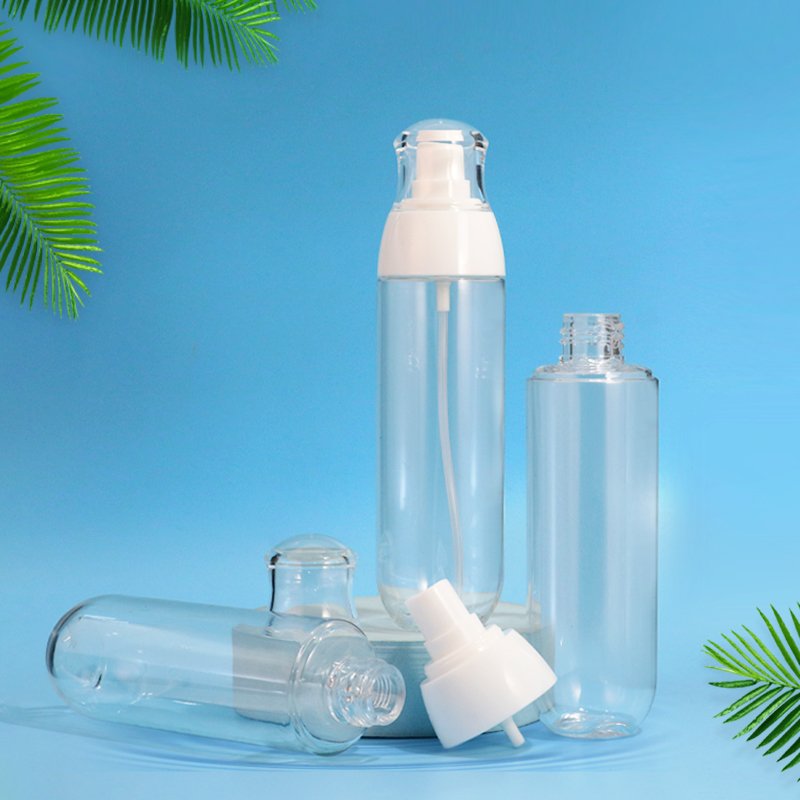
A spray system turns liquid into droplets with a small pump. The actuator, spring and piston force liquid up the dip tube and atomize it through a nozzle. For toners and mists, specify three things: output per stroke (fine mist 0.08–0.12 mL, standard 0.12–0.20 mL), neck finish (20/410 is the common small-bottle standard), and a clutch closure with the correct torque to stop leaks in transit.
The spray head is the part your customer touches every day, and the part most likely to fail in the box. This guide covers how sprayers work, the numbers that matter, and how to specify one that fits your bottle and protects your formula.
Spray specs at a glance
- Mechanism: piston or pistonless pump; dip tube draws product, actuator atomizes, return spring resets.
- Fine mist output: 0.08–0.12 mL per stroke - even facial coverage, low waste.
- Standard output: 0.12–0.20 mL per stroke - targeted application, toners.
- Common neck: 20/410 for small mist bottles; 18/20 mm crimp for perfume.
- Leak control: clutch closure at 12–18 in-lb on 20/410, locked actuator for transit.
- ShiJin: 1,000+ open molds, MOQ 5,000, 15–25 day production, spray profile reports on request.
How Does a Spray Pump Actually Work?
A sprayer is a miniature pump. Press the actuator and a piston or pistonless chamber draws liquid up the dip tube. The liquid hits the actuator's swirl chamber and leaves as a cone of droplets.
A return spring resets the chamber on release. That is why a new bottle needs a few priming pumps before the first fine mist appears. The dip tube must reach the base, or the last 5% of product stays behind.
Two variants dominate. Crimp-on sprayers are pressed onto a fixed neck and seal permanently. Screw-on sprayers thread onto a standard neck and can be removed or refilled. The choice changes both the look and the refill story.
Crimp-On vs. Screw-On: Which Should You Choose?
Crimp-on sprayers suit perfume and premium mists. The seal is permanent and tamper-evident, and the collar looks clean. The trade-off is no refill and a crimping step at the line.
Screw-on sprayers suit toners, daily skincare and refillable systems. The head threads on a standard neck, so the bottle can be opened, refilled or replaced. Most 20/410 mist bottles use screw-on sprayers for this reason.
Pick by the use case, not the look. If the product is used up and discarded, crimp is fine. If you want a refill story or easy capping, screw-on wins. See our refillable systems guide for the full picture.
Fine Mist vs. Standard Spray: What Is the Difference?
Output per stroke is the number that defines the feel. Fine mist sprayers deliver about 0.08–0.12 mL per actuation. The droplets are small and the coverage is even, which suits facial mists and setting sprays.
Standard sprayers deliver about 0.12–0.20 mL per stroke. The pattern is broader and slightly wetter, which suits toners and body mists where even, light coverage still matters but speed helps.
Spray angle and droplet size follow output. A wide angle with fine droplets suits the face. A narrower jet suits hair mist or targeted application. Match the actuator shape to the gesture the customer will make.
Why Does the Neck Finish Decide Compatibility?
The neck finish is the thread standard that lets bottle and sprayer mate. A 20/410 neck means a 20 mm diameter with a 410 screw standard - the workhorse for small mist bottles. Perfume often uses an 18 mm or 20 mm crimp neck instead.
If the sprayer neck does not match the bottle, the part will not seal or will cross-thread. Confirm the neck before tooling the mold. Most open-mold mist bottles at ShiJin are built to 20/410 so standard screw sprayers fit directly.
Do not assume. A bottle listed as "mist" can still carry a 24/410 neck meant for a lotion pump. Check the finish code, not the category name.
How Do You Stop a Spray Bottle from Leaking in Transit?
Leaks come from three places: wrong torque, an unlocked actuator, or a dip tube that sits proud. Control all three.
- Apply the right torque. A 20/410 screw sprayer is commonly applied at 12–18 in-lb. Too loose leaks; too tight cracks the neck or strips the thread.
- Lock the actuator. Most sprayers close with a half-turn or a clip for transit. Verify the lock in the packed sample, not just on the line.
- Seat the dip tube. It must reach the base without kinking. A kinked tube starves the spray; a short tube leaves product behind.
Run a 24-hour inverted leak test on filled, capped and locked units before shipment. Combine it with the drop and top-load tests that prove the bottle body. Request a spray profile report with output per stroke and pattern photos.
How Do You Match the Sprayer to the Product?
Use the product to set the spec, then confirm the bottle neck matches.
- Facial mist - fine atomization, wide angle, 0.08–0.12 mL, soft actuator.
- Setting or toning mist - fine to standard, even coverage, 0.10–0.18 mL.
- Hair or body mist - directional jet, standard output, 0.15–0.20 mL.
- Refillable system - screw-on sprayer on a standard neck so the bottle survives refills.
Material still matters. PET and PETG suit most water-based toners; HDPE handles some actives better. Check the formula against the bottle as you would for any pack - our compatibility guide covers the protocol.
At ShiJin you can spec the sprayer with the bottle from 1,000+ open molds, MOQ 5,000 units, 15–25 day production, and a spray profile report on request so the output and seal are proven before mass runs.
Frequently Asked Questions
How does a spray bottle pump work?
A sprayer is a small pump. Pressing the actuator draws liquid up the dip tube through a piston or pistonless chamber, then atomizes it through a swirl nozzle into a cone of droplets. A return spring resets the chamber, which is why a new bottle needs a few priming pumps before the first fine mist appears.
What is the difference between fine mist and standard spray?
Fine mist delivers about 0.08 to 0.12 mL per stroke with small, even droplets for facial coverage. Standard spray delivers about 0.12 to 0.20 mL per stroke with a broader, slightly wetter pattern for toners and body mists. The choice follows the product and the gesture the customer makes.
Can I put any sprayer on any bottle?
No. The sprayer must match the bottle neck finish. A 20/410 neck is the common standard for small mist bottles; perfume often uses an 18 or 20 mm crimp neck. Check the finish code, not the category name, or the sprayer will not seal.
How do I prevent spray bottles from leaking in transit?
Apply the correct torque, about 12 to 18 in-lb on a 20/410 neck, lock the actuator for transit, and seat the dip tube to the base without kinking. Then run a 24-hour inverted leak test on filled and locked units before shipment.
Should I choose crimp-on or screw-on spray?
Crimp-on suits perfume and premium mists where a permanent, tamper-evident seal matters. Screw-on suits toners, daily skincare and refillable bottles because the head threads on a standard neck and can be opened or refilled. Pick by the use case, not the look.
Matching bottle options for this topic
Real molds from our library in a comparable material and size class — each product page carries the full spec sheet, neck size, MOQ and lead time.
- PET Cosmetic Bottle 128ml — SKU SJT0157-128
- PET Cosmetic Bottle 180ml — SKU SJT0504-180
- PET Cosmetic Bottle 300ml — SKU SJT0087-300
- PET Cosmetic Bottle 500ml — SKU SJT0546-500
Need a spray system that fits your bottle and formula?
Browse our 1,000+ open molds or request a quote with your formula and target output per stroke. We will match the neck, the sprayer and the leak test to your product.
Browse Mold Library Request a Quote