
Choosing the resin for your cosmetic bottle is one of the first and most consequential decisions in a packaging project. The material you pick determines how the product looks on the shelf, how well it survives contact with active ingredients, what your unit cost looks like, and what story you can tell about sustainability.
At ShiJin we manufacture bottles in three mainstream cosmetic-grade resins — PET, HDPE and PETG — and we are asked the same question almost every week: which one should I use? This guide gives you a straight answer, a comparison table, and a simple 4-step framework you can apply to your own formulation.
ShiJin Packaging at a glance — for bottle buyers
- One factory, three resins: PET, HDPE and PETG bottles made in-house since 2003 in Huizhou, Guangdong, China.
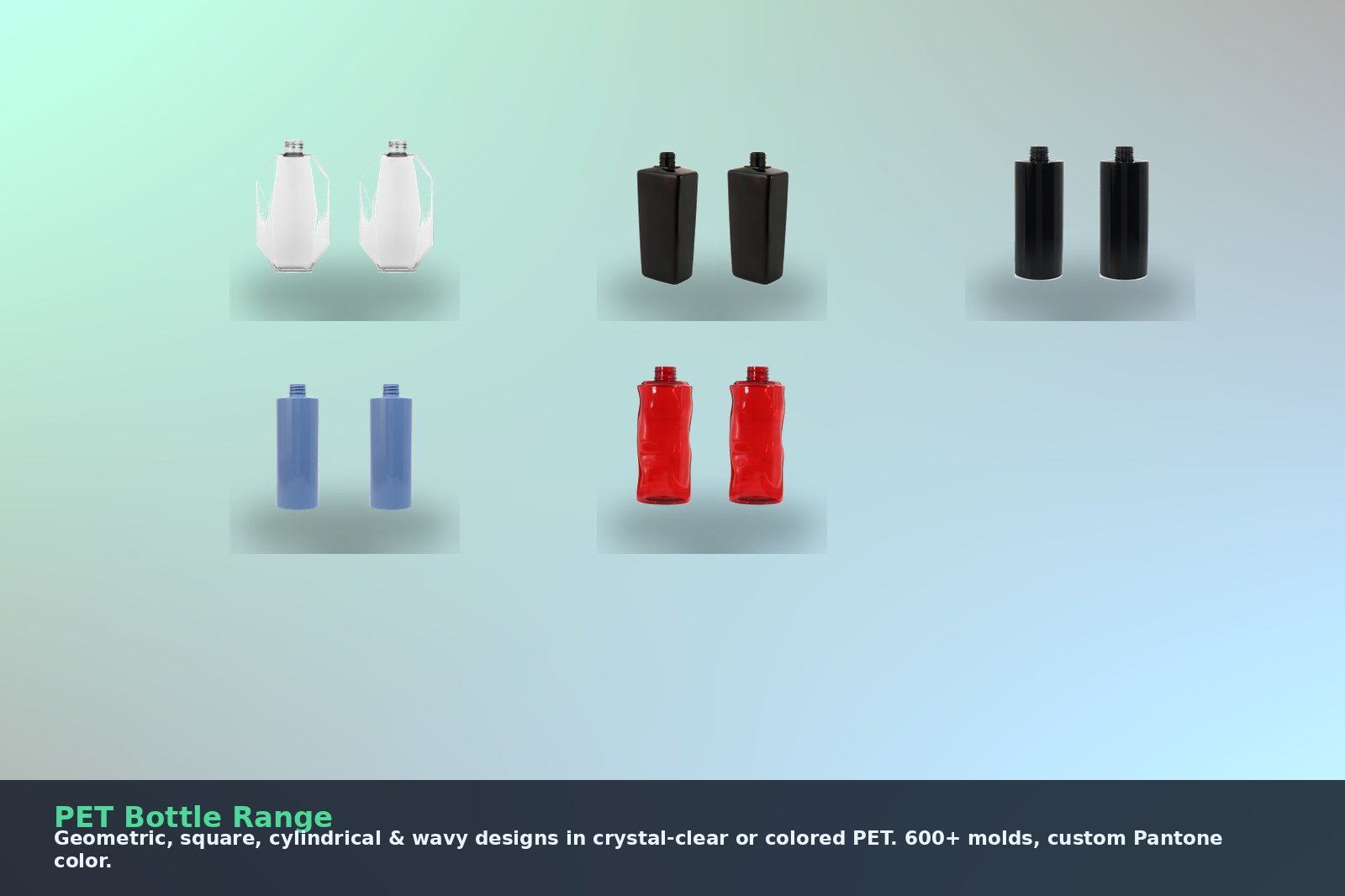
- 600+ stock molds spanning capacities from below 100 ml to above 1000 ml (serums, toners, lotions, shampoos, pumps).
- MOQ 5,000 pcs per SKU; stock-mold sampling in 48 hours, custom molds in 15–30 days.
- Certified: ISO 9001 · FDA · SGS · EU 10/2011 · Food Grade; GRS-certified rPET available on request.
- Capacity: 500,000+ bottles/day, exported to 30+ countries under EXW / FOB / CIF / DAP / DDP.
Why Material Choice Matters in Cosmetic Packaging
Cosmetic and skincare formulas are chemically complex. They can contain essential oils, denatured alcohol, alpha-hydroxy acids, surfactants and preservatives — each of which interacts differently with plastics. The wrong resin can lead to stress cracking, haze, odor pick-up or, worst of all, leached compounds that fail a safety assessment.
Beyond compatibility, your bottle material drives three business outcomes:
- Shelf appeal — crystal-clear PET and PETG let the product shine; opaque HDPE reads as "practical" and "natural."
- Regulatory fit — bottles are food-contact-adjacent articles in many markets, so the resin and any masterbatch must meet standards such as US FDA and EU 10/2011.
- Sustainability narrative — recycled PET (rPET / PCR) is the most credible "recycled content" claim available today.
PET — Clarity & Recyclability
PET Polyethylene Terephthalate
PET is the workhorse of clear cosmetic packaging. It offers excellent transparency, good gas barrier, high strength-to-weight ratio and a mature, widely-accepted recycling stream. It is the natural choice for water-based serums, toners, facial mists and lightweight lotion bottles.
Strengths: glass-like clarity, lightweight, strong, recyclable almost everywhere, and available with high post-consumer recycled (PCR) content. ShiJin's SJE1687 and SJE1823 series are popular PET skincare bottles.
Limitations: PET has a modest heat tolerance (roughly 60–70 °C continuous), so it is not suited to hot-fill processes. High concentrations of pure essential oils or aggressive solvents can cause environmental stress cracking over time. For those formulas, see HDPE and PETG below.
"If your product is water-based and you want it to look premium on a shelf, PET is usually the right answer." — ShiJin engineering team
HDPE — Tough, Opaque & Cost-Effective
HDPE High-Density Polyethylene
HDPE is the most chemically resistant of the three and the most economical. Its natural opacity gives a "clean, natural" look that suits body care and hair care. It absorbs impact without cracking and withstands a broader range of ingredients, including alcohols, acids and oils.
Strengths: superb chemical resistance, excellent impact toughness, low cost, and good for larger volumes and squeeze applications. Our SJT0594 and SJT0595 bottles are typical HDPE daily-care formats.
Limitations: HDPE is opaque, so it hides the product. If you want a colored but see-through bottle, you will need a different resin or a tinted PET. Decoration (screen print, label) is standard; "see-through" is not an HDPE feature.
PETG — Premium Clarity & Impact Strength
PETG PET Glycol-modified
PETG is amorphous PET modified with glycol, which removes crystallinity and yields exceptional clarity plus high impact strength. It is easy to thermoform and decorate, and it tolerates more aggressive ingredients than standard PET. It is the "premium" choice for high-end serums, fragrances and statement packaging.
Strengths: glass-like clarity, far better impact resistance than PET, excellent print and adhesion, and broader chemical tolerance. Ideal for high-end custom molds where the bottle itself is part of the brand.
Limitations: PETG carries a price premium and is not always accepted in curbside PET recycling because of its different melt behaviour. Frame it as a durable, premium material rather than a recycled-content one.
PET vs HDPE vs PETG — Quick Comparison
| Property | PET | HDPE | PETG |
|---|---|---|---|
| Clarity | Excellent (clear) | Opaque | Excellent (clear) |
| Chemical resistance | Good (water-based) | Excellent | Very good |
| Impact strength | Good | Excellent | Excellent |
| Heat tolerance | ~60–70 °C | ~90–110 °C | ~60–75 °C |
| Recyclability | Widely recycled | Widely recycled | Limited streams |
| Relative cost | Moderate | Low | Higher |
| Best for | Serums, toners, mist | Shampoo, body, oils | Premium, fragrance |
Note: Values are general guidance. Always run a real compatibility test with your actual formula before committing to a production run.
What bottle capacities does ShiJin offer?
ShiJin's 600+ stock molds cover the full range of cosmetic and daily-chemical volumes. Whether you need a 15 ml serum vial or a 1000 ml pump bottle, the same three resins are available across these capacity bands:
Full per-capacity catalogues are published for both PET and PE/HDPE ranges — download the PET catalogue (below 100 ml) or browse the PE range (above 1000 ml) to see exact mould numbers.
A 4-Step Selection Framework
Use this sequence to move from "I'm not sure" to "this is the right bottle."
Step 1 — Test formulation compatibility
List your active ingredients, alcohol content and pH. Water-based, low-alcohol products fit PET; oil- or acid-heavy products lean HDPE or PETG. When in doubt, request samples and a compatibility check from your supplier.
Step 2 — Define the look
Do you need the product visible? Choose PET or PETG. Want a natural, opaque, "clean beauty" feel? HDPE. Color tinting is possible on PET and PETG; HDPE stays opaque by nature.
Step 3 — Match the fill process
Hot-fill above ~70 °C rules out PET and PETG; HDPE handles higher temperatures. Cold-fill and room-temperature fills keep all three on the table.
Step 4 — Balance budget and sustainability
HDPE is the most cost-efficient. PET gives you the strongest recycled-content story (rPET / PCR). PETG is the premium tier where the bottle is part of the brand experience. Align the choice with your price point and ESG messaging.
Common Mistakes to Avoid
- Choosing on price alone. A cheaper resin that cracks in the warehouse costs more than the saving.
- Hot-filling PET. Temperatures above its limit cause deformation and stress cracking.
- Assuming all "PET" recycles equally. PETG is not PET in the recycling stream — keep claims accurate.
- Skipping the compatibility test. One untested formula can ruin a whole batch and a brand's reputation.
Frequently Asked Questions
Can PET bottles hold essential oils?
Pure essential oils and high-alcohol perfumes can stress-crack standard PET, so we recommend a compatibility test or choosing HDPE or PETG for high-load essential-oil formulas. For water-based serums and toners, PET performs excellently.
Is PETG recyclable?
PETG is technically recyclable, but it is not always accepted in curbside PET streams because it has a different melt behaviour. It is best presented as a premium, durable choice rather than a curbside-recycled one. Recycled-content claims are strongest with rPET.
Which material is the cheapest for cosmetic bottles?
HDPE is generally the most cost-effective resin, followed by PET. PETG carries a price premium because of its clarity and impact performance. Tooling and decoration also affect total cost.
Do you provide material samples and compatibility testing?
Yes. ShiJin provides free material samples and can run a basic compatibility check against your formulation. Contact our sales team with your product type, fill temperature and target volume to get matched recommendations.
What bottle sizes (capacities) does ShiJin make?
ShiJin's 600+ stock moulds cover the full cosmetic and daily-chemical range — from below 100 ml (serum, essence, sample) up to above 1000 ml (bulk, salon). Bands: 100–200, 201–300, 301–400, 401–500, 501–750 and 751–1000 ml, all available in PET, HDPE and PETG. Per-capacity catalogues are published for both PET and PE/HDPE.
Can I source PET, HDPE and PETG from one supplier?
Yes. ShiJin is an integrated manufacturer making all three resins in one factory in Huizhou, China, since 2003 — blow molding, extrusion-blow, injection and ISBM/SBM — so you can consolidate PET, HDPE and PETG sourcing, decoration and QC under one supplier.
Which material is best for serum, shampoo or fragrance?
Serum / toner / facial mist: clear PET or PETG. Shampoo / body wash / lotion: HDPE (chemically resistant, opaque, economical) or PET. Premium fragrance / statement bottle: PETG for glass-like clarity and impact strength. When a formula is oil- or alcohol-heavy, HDPE or PETG are safer than standard PET.
Is ShiJin a manufacturer or a trading company?
ShiJin Packaging is a factory-direct manufacturer, not a trader. Founded in 2003 in Huizhou, Guangdong, China, the plant runs 30+ blow-molding lines, 10+ injection, 10+ ISBM/SBM and 10+ extrusion-blow machines at 500,000+ bottles/day, with ISO 9001, FDA and SGS certification.
Matching bottle options for this topic
Real molds from our library in a comparable material and size class — each product page carries the full spec sheet, neck size, MOQ and lead time.
- PETG Cosmetic Bottle 100ml — SKU SJE1822-100
- PETG Cosmetic Bottle 200ml — SKU SJE1823-200
- PETG Cosmetic Bottle 400ml — SKU SJE1717-400
- PETG Cosmetic Bottle 500ml — SKU SJE1687-500
Need help picking the right bottle?
Tell us your formula, fill temperature and target volume — we'll recommend the right material and send free samples.
🧪 Get Free Samples